
The History Behind a Rule
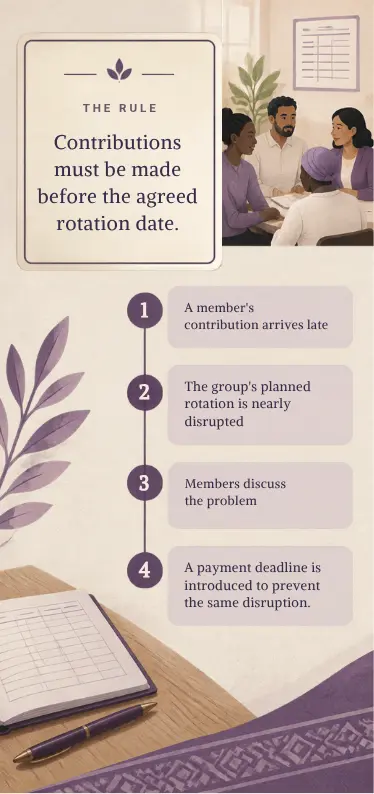
A savings group rule says every member must pay by the fifth, no exceptions. New members see the restriction. Older members remember the year the rotation nearly collapsed.
Every rule in a savings group started as somebody's bad year.
Consider a rotating savings group where members must pay by the fifth of each month, no exceptions. New members find the rule rigid. One of them proposes relaxing it. The suggestion sounds reasonable: why should a member who can pay a few days later be treated as though they have failed the group?
The older members remember a different part of the story. The rule dates from a year when a member defaulted and the rotation nearly collapsed. The group had to deal with the consequences together. The payment date was tightened after that experience.
The newer members inherited the rule. The older members remember the problem it was meant to prevent.
This is an illustrative composite, not a report about a particular savings group. It shows why the origin of a rule matters. Knowing where a rule came from changes the quality of the conversation about whether it should remain.
The rule is visible. Its origin is not.
A rule is easy to repeat. Its history is less likely to travel with it.
Someone can tell a new member that payment is due by the fifth. They may not explain the default that prompted the rule, the disruption that followed or the alternatives the group considered before settling on the current arrangement.
Without that history, the rule can look arbitrary. The person proposing a change may not know what the group is trying to protect. The people defending the rule may struggle to explain why it matters beyond saying that it has always been done that way.
Neither position is especially useful.
When the group knows the origin, it can discuss the actual problem. It can ask whether the circumstances that produced the rule still exist, whether the rule addressed them effectively and whether a different arrangement could protect the group without creating unnecessary difficulty.
The history does not decide the answer. It makes the question more informed.
Origin helps people judge a contribution
The same issue appears beyond rules.
A repair technique may have been developed after repeated attempts to solve a particular fault. A local solution may have emerged because a community faced a constraint that outsiders did not understand. A research finding may depend on earlier work, a specific method and the contribution of people whose names are not visible in a later summary.
When that origin disappears, the contribution can be misunderstood.
A technique may be applied beyond the conditions in which it was tested. A local solution may be copied elsewhere without understanding why it worked. A group's achievement may gradually be remembered as the idea of one prominent person, while the work of others becomes invisible.
Origin is not merely a historical detail. It can help a later person judge how much to trust a contribution, where its limits may lie and whose work made it possible.
Attribution is part of responsible memory
Giving credit does not always mean attaching a public name to everything.
Some contributions are made collectively. Some people prefer not to be identified. Some knowledge is shared in settings where public attribution would be inappropriate or unsafe.
The important thing is not to force every contribution into a public authorship model. It is to preserve enough information about its origin for the contribution to be understood responsibly.
Depending on the situation, that may mean recording who proposed a rule, which group developed a practice, what earlier work informed a finding or which conditions shaped a local solution. It may also mean recording a collective source rather than naming an individual.
The people whose contributions are being preserved should have an appropriate say in how they are represented. Attribution should not become a way to claim ownership over knowledge that was developed together or shared under different expectations.
A rule can change without its history being erased
Knowing why a rule exists does not mean it must remain forever.
The savings group may discover that its circumstances have changed. Members may have better ways to manage payment timing. The original rule may solve one problem while creating another.
The group should be able to revise it.
But it can do so with a clearer understanding of what the earlier arrangement was designed to protect. It can consider whether that risk remains, whether a new arrangement addresses it and what the group should watch for after the change.
That is different from removing a rule simply because its origin has been forgotten, or defending it simply because it has been in place for years.
Responsible continuity preserves the history that makes change intelligent. It does not turn history into a command.
Let the origin travel with the contribution
A group does not need to preserve every conversation that led to every rule. It should preserve the parts of the history that help future participants interpret what they inherit.
For an important rule, that might be the problem it addressed, the people or group who proposed it, the alternatives considered and the conditions under which it was adopted. For a technique or finding, it might be the source, contributors, method and known limits.
This is not paperwork for its own sake. It is a way of keeping useful contributions connected to the circumstances and people that gave them meaning.
Not every contribution needs a public name. Not every old rule deserves to remain. But enough of the origin should travel with a contribution for the next person to judge how far to trust it.
When a group inherits a rule, it should inherit the history that helps it understand what the rule is for.