
Not Everything Should Be Kept or Shared
Someone shares something painful after a fellowship meeting because they trust the room. The group may learn from the moment without turning the person's story into a permanent public record.
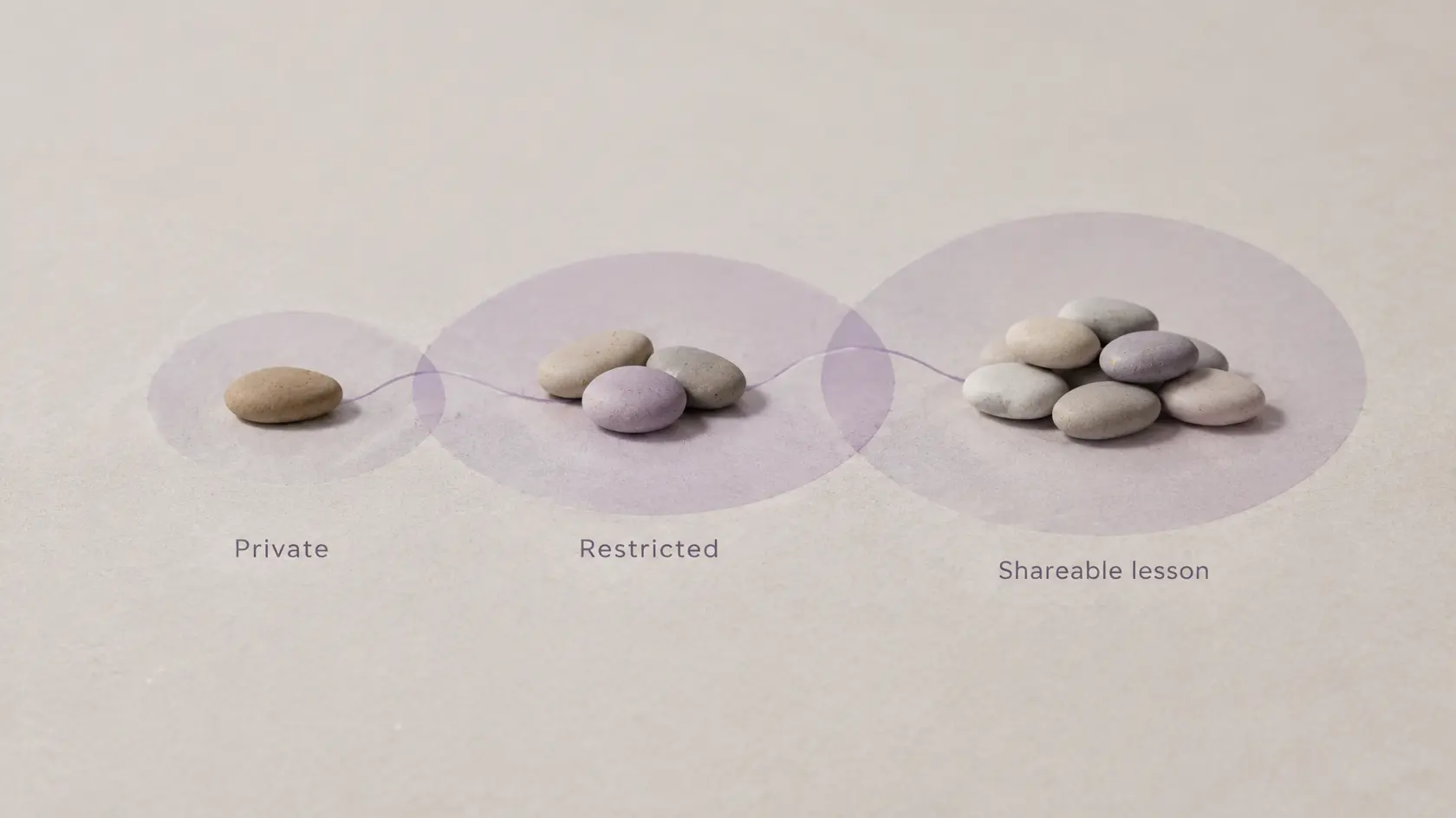
At a fellowship meeting after service, someone shares something painful because they trust the room.
The group listens. The experience changes how some people understand what others may be carrying. It may shape how they support one another or how they approach a similar situation in the future.
Later, someone suggests recording what happened so the group does not lose what it learned.
That intention can be good. But it raises a different question: does preserving the lesson require preserving every personal detail? Should the account be available to anyone who joins the group later? Did the person share the story expecting it to become a lasting record?
The answer is not automatically yes.
This is an illustrative composite, not a report of a particular fellowship. It points to a boundary that matters wherever people learn through shared experience: preserving what a group learned does not mean preserving everything anyone said.
Learning from something is not the same as owning it
A group can learn from an experience without acquiring unrestricted rights to the story behind it.
The person who shared something painful may have done so because they trusted a particular room and the people in it. Their willingness to speak in that setting should not be treated as permission to make the details permanently available elsewhere.
The same distinction appears in other settings.
A small business develops a process that saves money. Some of the lesson could help others in the same trade, while the exact method or commercial detail remains sensitive.
A mentor tells one person about a difficult year in her own life to help them through theirs. The person receiving the story may carry an important lesson, but the mentor gave that account to one person, not to an unlimited audience.
The value of learning does not cancel the expectations under which information was shared.
Preservation and access are different decisions
Groups sometimes speak about keeping information as though the next question must be who can see it.
But these are separate decisions.
A group may decide that a particular lesson is worth recording while restricting access to the underlying account. It may keep a summary that removes identifying details. It may preserve a decision without retaining the sensitive conversation that informed it. It may decide that nothing should be recorded at all.
Likewise, making a record visible to one person does not mean it should be available to every member, partner or future participant.
Access should reflect the purpose of the information and the expectations of the people involved. A record created to help a small team coordinate a sensitive matter should not silently become a general resource.
This is not a technical detail to settle after the record has been created. It is part of deciding what should be preserved in the first place.
Ask what permission actually covers
Permission is not a single, unlimited yes.
Someone may agree to share information with a particular person or group for a specific purpose. That does not necessarily mean they agree to have it stored indefinitely, circulated to future members, quoted publicly or reused in another context.
A group should be clear about what it intends to keep, why it needs it, who should have access and how long the information remains useful. Where the information concerns a person, the group should consider what they were told and what they agreed to.
Circumstances can change. A person may ask for identifying details to be removed. A record may no longer serve its original purpose. Information that was appropriate for a small group may become harmful if the audience expands.
Sometimes the responsible response is to restrict access, anonymise the material, correct it or delete it.
The ability to preserve knowledge should not become an excuse to ignore the people from whom that knowledge came.
Not every useful detail needs to be retained
There is also a practical reason to be selective.
Keeping everything can make important information harder to find. It can preserve details that are no longer relevant, create unnecessary exposure and make it difficult for people to understand what the group actually learned.
A responsible record focuses on what serves a legitimate purpose.
For the fellowship group, that might mean retaining a general lesson about how to support someone in a difficult period, without keeping the person's private account. For the business, it might mean recording a general process improvement while restricting the commercially sensitive details. For the mentor's conversation, the right record may be no record at all.
These choices depend on the people and circumstances involved. There is no universal rule that every experience should be documented in the same way.
Boundaries are part of continuity
A group that wants to carry understanding forward needs to know what should not travel.
Without boundaries, preservation can undermine the trust that made people willing to share in the first place. People may become less willing to speak honestly if they believe every conversation could become a permanent record for an unknown audience.
Responsible memory therefore requires more than the ability to keep information. It requires judgement about purpose, consent, access, accuracy and the right to change or remove what is no longer appropriate to retain.
Some knowledge can be shared widely. Some should be available only to particular people. Some should be transformed into a less identifying lesson. Some belongs in the room where it was shared.
The point is not to preserve the maximum amount of information. It is to preserve what can responsibly serve the people and work involved.
Whatever a group keeps should remain as safe as the room in which it was shared.