
Two Teams Inherit the Same Project
One team receives the budget, contact list and next meeting date. The other receives those things and understands why the project began, what was tried and what remains uncertain.
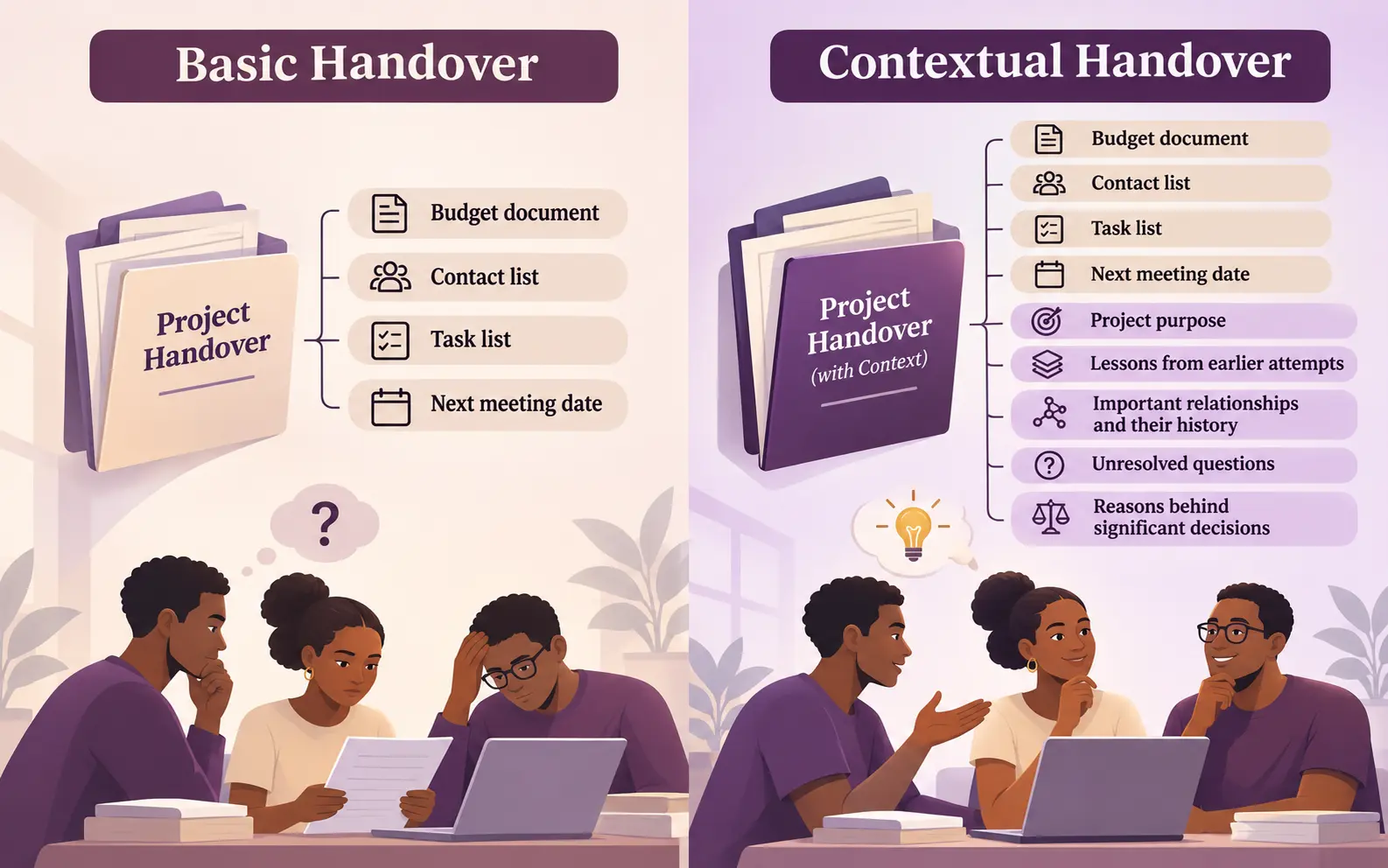
Two groups take over the same community project.
The first is given the budget, the contact list, the open decisions and the date of the next meeting. They start work that afternoon, and for a while it goes well.
The second is given all of that and more. They know why the project began and what the last group learned about what the community needed. They know which approaches were tried and dropped, which relationships need careful handling and where the last group admitted it was unsure.
Both groups have the basic materials required to continue. But they have inherited different amounts of understanding.
The second group is under no obligation to follow the old plan. The history is what lets them change it sensibly. The first group will change things too, and some of those changes will be ideas the old team had already tested.
This is an illustrative composite. The contrast is not between a capable team and an incapable one. It is between two kinds of handover—and the different starting points they create.
The first team inherits the work's visible state
A budget shows what resources remain. A contact list identifies people who have been involved. A list of open decisions tells the new group what has not yet been settled. The next meeting date gives them an immediate point of coordination.
These are important. Without them, the incoming team may struggle to know where to begin.
But the documents do not necessarily explain why the project began, what the previous group discovered or how the current situation came about.
The first team may repeat an approach that was already tried and dropped. It may approach a relationship without knowing the history that makes it sensitive. It may treat an unresolved question as though nobody has investigated it, or assume that a previous plan is still appropriate because it is the only plan available.
The team can still succeed. It may learn quickly, bring new ideas and build stronger relationships. But it begins without some of the understanding that the previous group had already developed.
The second team inherits the reasoning too
The second team receives the same basic materials, but its handover includes a wider account of the project.
It understands the need that prompted the work. It knows what the previous group heard from the community, which approaches were tested and why some were dropped. It can see where the earlier team reached a conclusion, where it remained uncertain and which relationships require care.
That history does not dictate the next move. It helps the new team understand the choices available.
If the community's needs have changed, the team can adapt the project with a clearer view of what changed. If an earlier approach failed, it can examine whether the same conditions still apply. If a relationship needs attention, the team can begin with an understanding of its history rather than treating it as a new contact.
The value of the handover is not that the new team inherits a perfect answer. It inherits enough context to ask better questions.
The same difference appears beyond community projects
A new research cohort may inherit a dataset, a project plan and a list of tasks. It also needs to understand which methods were tried, why some were abandoned and what limitations the previous researchers recognised.
An apprentice who starts teaching others needs more than the technique itself. They need to understand the mistakes that refined it, the situations in which it works and the jobs where it should not be used.
A younger generation taking over a family business may inherit its accounts, suppliers and customer records. They also need the history behind important relationships, the lessons from earlier decisions and the reasons certain arrangements were made.
In each case, the incoming people should be free to change what they inherit. Continuity is not a demand to preserve every old practice.
It is the ability to begin from a more informed position.
A richer handover takes work before the handover
The second kind of transition is harder to produce if the outgoing group waits until its final meeting.
The people leaving may not remember every important detail. Some knowledge is difficult to explain without the original situation in front of them. Some relationships cannot be transferred through a document. The incoming team may not yet know which questions it needs to ask.
A stronger handover is built throughout the work.
Groups can record why important decisions were made, what they learned from attempts that did not work, which questions remain open and what conditions shaped their approach. They can invite newer participants to observe and contribute before responsibility changes. They can introduce successors to important relationships where that is appropriate and welcomed.
The aim is not to produce an enormous archive. It is to make the history that matters easier to find and discuss.
It also requires honesty. A handover should not make the previous group look more certain or successful than it was. Unresolved questions, mistakes and doubts are part of the inheritance. They help the next group understand where caution is needed and where new investigation could be valuable.
Inherit the freedom to change things intelligently
The first group can continue the project. The second can continue it with more of the story.
That difference matters because the next team will make changes regardless. New people bring different priorities, conditions shift and plans meet realities that the previous group could not fully anticipate.
The question is whether those changes begin with an understanding of what came before.
A good handover does not ask the next group to obey the past. It gives them enough evidence, reasoning and context to decide what deserves to continue, what should change and what can be left behind.
The same principle applies to research, practical learning, businesses and associations. Responsibility changes hands. The people change. The work can still accumulate understanding.
The best handover does not tell the next group what to do. It helps them understand enough to choose what to do next.