
The Handover Folder That Starts the Same Work Again
The new executives inherit the documents. What they do not inherit is why the previous team stopped using the hall, or why a promising partnership went quiet.
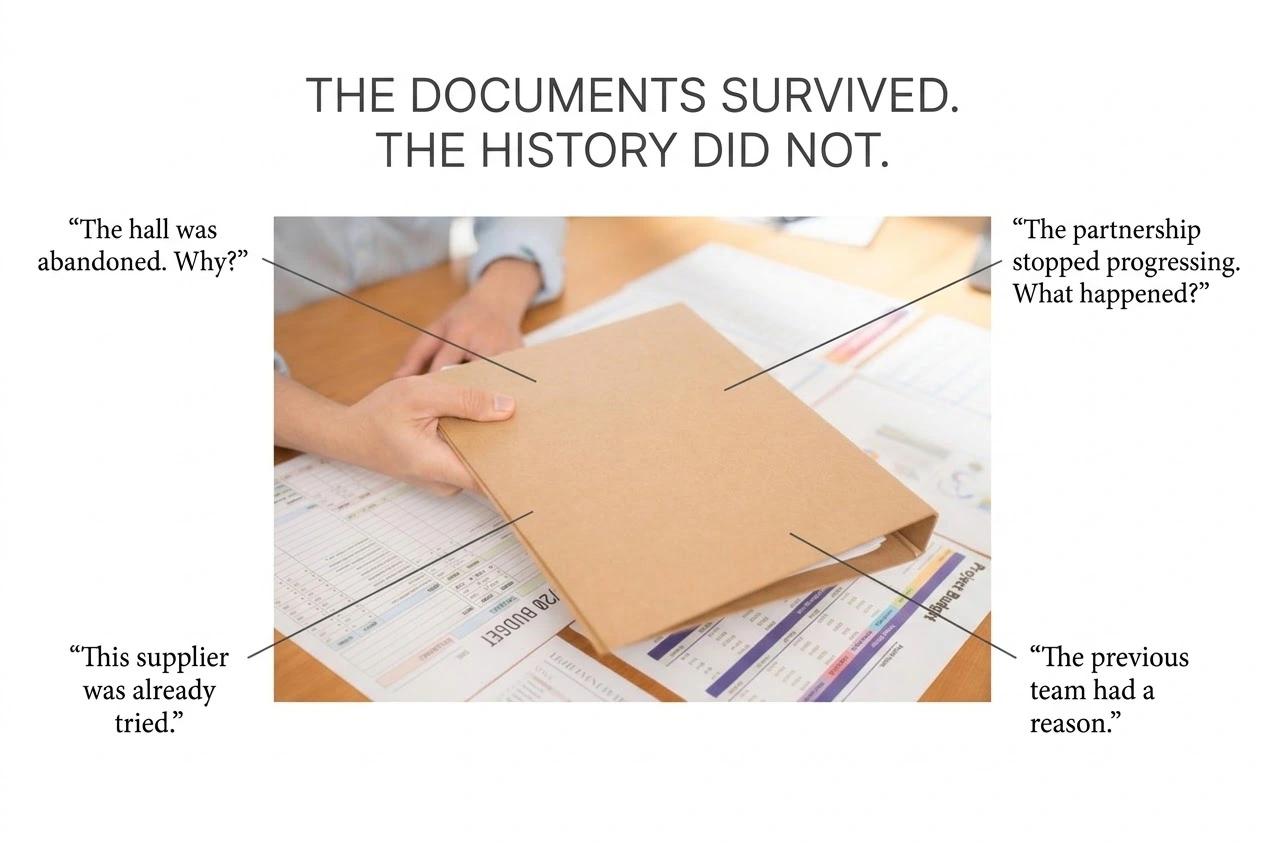
The new executives inherit a folder. It holds the event reports, the budgets and a list of outstanding tasks.
On paper, the handover looks organised. The documents are there. The previous team's activities have been recorded. The new executives can see what was spent, what was completed and what remains unfinished.
But the folder does not say why the last team stopped using the main hall, or why a promising partnership went quiet.
So the new team books the hall again, chases the same late supplier for three weeks and approaches the partner as if nobody had spoken to them before.
The problem is not that the incoming executives are careless. The lessons never arrived.
This is an illustrative composite, not a report about a particular association. It describes a gap that can appear whenever responsibility changes hands: the incoming group receives the visible records of the work without the history that would help it interpret them.
A handover is more than transferring files
A handover is often treated as an administrative event. Someone leaves, someone else takes responsibility, and documents are passed across.
Those documents matter. Reports, budgets, schedules, contact lists and task records provide a starting point. They establish what happened and what needs attention.
But a new team also needs to understand how the work reached its current state.
Why was one venue abandoned? Which supplier repeatedly failed to deliver on time? Why did a partnership that looked promising stop progressing? Which approach was tested and found unsuitable? Which commitment remains open because the previous team could not resolve a particular constraint?
These are not minor details. They can determine whether the next group makes a sound decision or repeats work that has already been done.
A handover that transfers files but not their relevant context can leave the incoming team with the appearance of continuity and the experience of starting again.
The cost of rediscovering old lessons
When the history is missing, the new team may repeat earlier attempts without knowing they have already been tried.
It might choose the same venue, approach the same supplier or restart a discussion that ended for a reason nobody recorded. The group spends time discovering what the previous team learned, often under pressure to deliver its own work.
Some repetition is unavoidable. Circumstances change, and an approach that failed previously may become viable under new conditions. A new team may also have better relationships, resources or ideas.
The important distinction is whether the group is revisiting an earlier decision deliberately or simply unaware that the decision and its reasoning already exist.
Deliberate reconsideration begins with context: what was tried, what happened, what constraints mattered and what has changed since. Accidental repetition begins without that understanding.
Why the missing context is rarely in the folder
The people preparing a handover may focus on what is easiest to list.
They can identify completed activities, attach reports, reconcile budgets and write down outstanding tasks. These items have clear boundaries and are often already documented.
The history behind them can be harder to capture.
A partnership may have gone quiet after several conversations that never became a formal agreement. A venue may have been abandoned because of a practical problem discovered during an event. A research approach may have been dropped after the team found a limitation that was discussed informally but never included in the final report.
People who participated may remember these details because they were present when they mattered. But unless someone asks what the next team needs to understand, those details can remain in individual memory.
The incoming team may not know which questions to ask. It sees a list of partners, not the history of the relationships; a venue name, not the reason it was avoided; a task marked incomplete, not the attempts that came before.
What a useful handover should carry
A useful handover does not need to preserve every conversation. It should give the next person enough context to understand the current state and make informed decisions.
For significant work, that might include:
- What happened: the activities, outcomes and current status.
- Why decisions were made: the reasoning, constraints and alternatives considered.
- What was tried: approaches that worked, failed or were stopped, and what the group learned.
- What remains uncertain: unanswered questions, assumptions and unresolved risks.
- Who is connected: relevant relationships and the appropriate context for approaching people.
- What has changed: conditions that may make an earlier decision worth revisiting.
The quality of this information matters more than the size of the folder. A concise explanation of why a partnership paused may be more useful than another long activity report.
The people preparing the handover should also involve the people receiving it. A conversation gives successors the chance to ask questions that the outgoing team may not have anticipated. Where possible, the handover should happen early enough for both groups to work through the context rather than simply exchange files on the final day.
Reopening a decision should be a choice
There is a danger in treating every previous decision as something that must be preserved indefinitely.
Some decisions were wrong. Some were temporary responses to conditions that no longer exist. Some should be challenged because new people have better information or a better alternative.
Continuity is not obedience to the past.
A good handover makes it easier to reopen a decision intelligently. It gives the next team the reasons behind the earlier choice, so they can understand what problem it was trying to solve and decide whether that problem still exists.
Without the history, a new team may mistake a temporary constraint for a permanent rule—or spend weeks reconstructing a discussion that could have been explained in a few lines.
The purpose of a handover is not to prevent the next group from changing anything. It is to make sure that change begins with understanding.
The question is not simply whether the previous team left its files. It is whether the next team inherited enough context to know what those files mean.