
When Everyone Knows Their Part but the Whole Still Fails
In a family business, each person can do their job correctly while the business loses a day because a change known to one person never reaches the others.
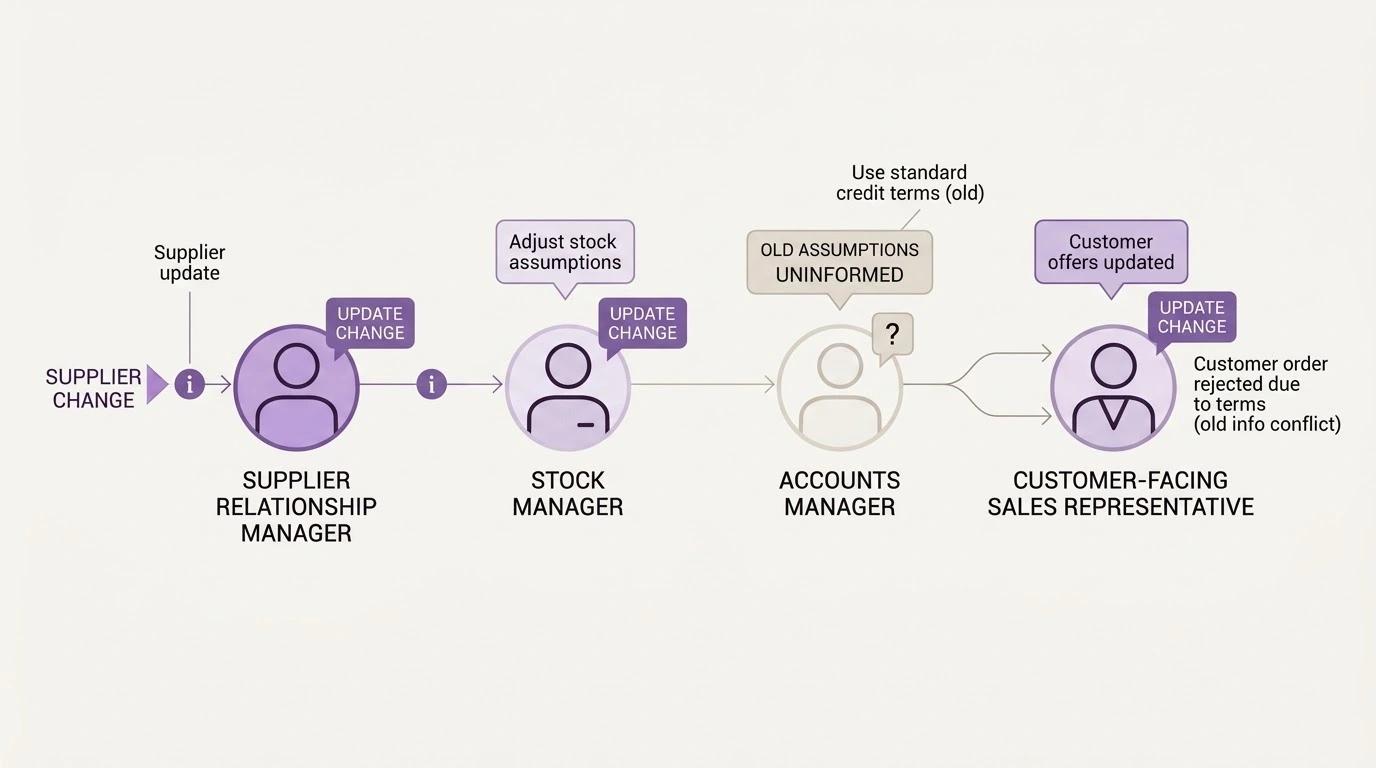
Everyone in the shop was doing their job, and the shop still lost a day.
In a family business, one person knows which suppliers can be trusted, another knows the regular customers and a third keeps the accounts. Each holds part of the picture.
On Tuesday, the supplier calls the person who manages the relationship and moves a delivery from Wednesday to Friday. She means to pass on the change. Meanwhile, the person managing stock has planned the week around Wednesday, the accounts are prepared to pay on delivery, and the person at the counter has promised a customer that the goods will be ready by Thursday.
The supplier has communicated the change. The person who received the call understands it. The stock plan, payment arrangement and customer promise have not caught up.
Nobody was careless. Each person acted on the information available to them. What failed was the movement of knowledge between people whose decisions depended on one another.
This family-business scene is an illustrative composite. Its purpose is to show how a group can contain the information it needs and still fail to act as though it shares that information.
Knowledge can be distributed without being connected
Groups rarely depend on every person knowing everything.
A business may divide responsibilities so that one person manages suppliers, another handles stock, another keeps accounts and another serves customers. A public health programme may rely on local workers who understand community concerns, clinic staff who manage service capacity and programme coordinators who organise resources.
A research team may have one member responsible for data, another for the method and another for communicating the findings.
This distribution can be useful. People develop expertise in different areas, responsibilities become manageable and work can happen in parallel.
The difficulty appears when one person's knowledge changes what another person needs to do.
The supplier's revised delivery date is not only a detail for the person who received the call. It affects stock planning, payment timing and the promise made to the customer. If those people do not receive the change in time, their decisions may remain reasonable in isolation and still produce a poor result together.
The problem is not simply that someone failed to communicate. The group needs to understand which information is relevant to whom, when it becomes relevant and what action should follow from it.
The cost of a missing connection
When important knowledge does not travel, the consequences can look like separate mistakes.
Stock may be ordered too early. A payment may be prepared for the wrong date. A customer may be given a promise the business can no longer keep. People may spend time correcting arrangements that would have been different if they had known about the change.
It is tempting to assign blame to the person who should have passed on the information. Sometimes responsibility really has been neglected. But the group should also examine whether its way of working makes these dependencies clear.
Did the person receiving the supplier's call know that the stock manager needed to be informed immediately? Was there an agreed place to record delivery changes? Did the person at the counter have a way to check whether a promise was still realistic?
These questions do not remove individual responsibility. They help identify whether the failure belongs to one action, a recurring gap in the process or both.
A group that responds only by telling people to communicate better may leave the underlying problem untouched.
The same gap appears in more complex work
The pattern is not limited to small businesses.
Similar gaps appear in public health programmes when local workers hear concerns that never reach those planning a service, and in research teams when a method's limitations do not travel with the data. In a student association, one executive may know a venue is unavailable while another continues publishing the old schedule. The information exists; the people making dependent decisions do not share the same current picture.
The details differ, but the coordination challenge is similar: knowledge is held by different people, and the work depends on those pieces being brought together at the right moment.
What does it take to connect the picture?
A group does not need to make every detail visible to everyone. That would create noise, and some information should remain restricted.
It does need to make important dependencies understandable.
People should know which changes affect their responsibilities, where those changes should be communicated and who needs to acknowledge them. Shared records can help, but only if people know what belongs there and can trust that the information is current. Regular check-ins can help, but they should focus on changes and decisions that matter rather than becoming meetings for their own sake.
It is also useful to make the reasoning behind a handoff explicit. Instead of passing on only a new date, the person can explain what the change affects: stock planning, payment timing and customer commitments. That makes it easier for others to see why the information matters and what they need to reconsider.
A reliable process should not depend entirely on one person remembering every connection. Where the same kinds of changes repeatedly affect multiple responsibilities, the group can make those dependencies part of how it works.
The group needs a shared picture, not identical knowledge
People do not need identical expertise. The supplier relationship manager may know things the stock manager does not. The person handling accounts may understand constraints that the others do not.
What they need is enough shared context to make decisions that fit together.
That means knowing when another person's information changes your own work, where to find the relevant update and how to ask for clarification when something does not make sense.
A group can have capable people, clear roles and a sensible plan and still struggle if the knowledge connecting those parts does not move.
Sometimes the missing resource is not another expert or another instruction. It is a dependable way for what the group already knows to reach the right person in time.
The question is not only what each person knows. It is whether the people who depend on that knowledge can access it when their decisions require it.