
Disagreement as Information
A programme planned for 200 people attracts 60. The argument that follows could become blame—or the beginning of a better explanation.
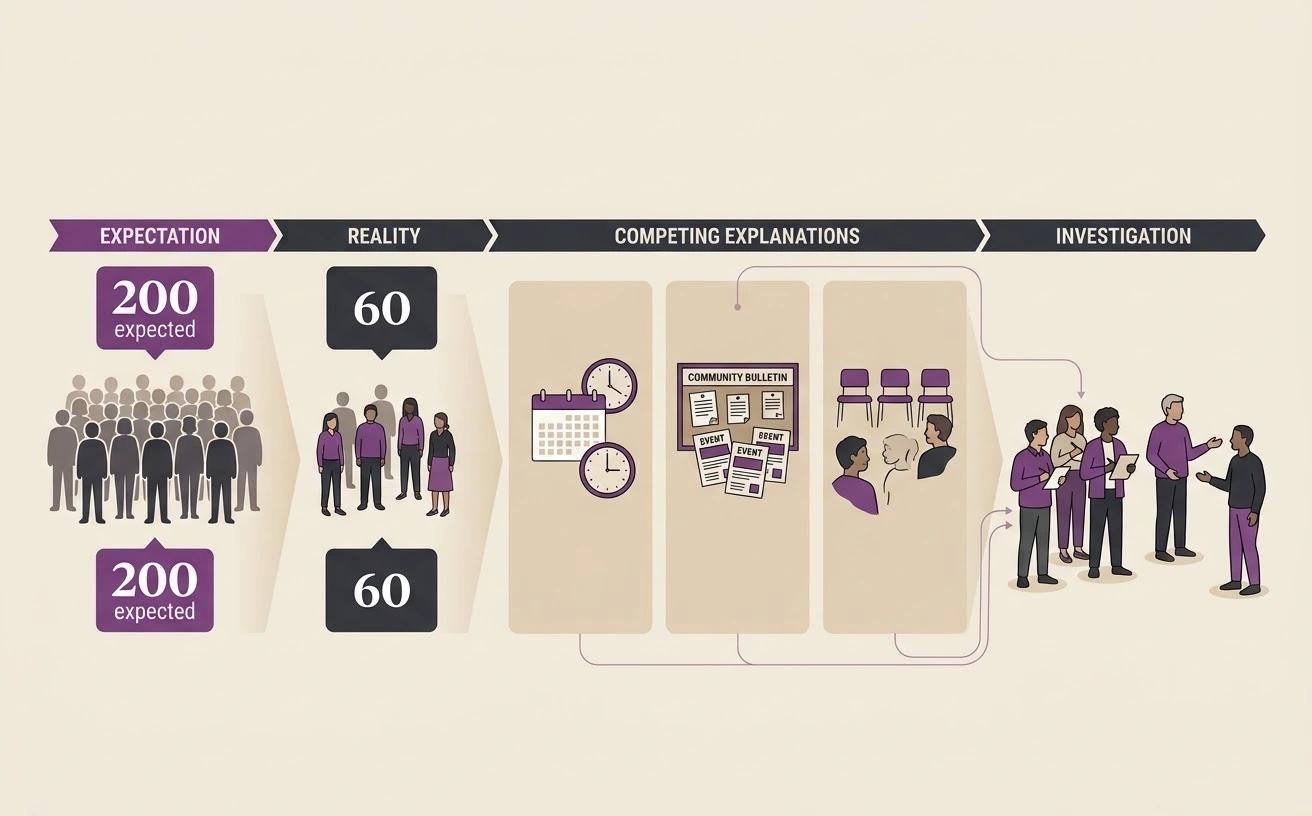
A community programme was planned for 200 people. Sixty came.
Within the hour, the planning group was arguing. One person said the announcement went out too late. Another said the date clashed with a funeral and market day. A third said the programme was never what people wanted.
Each explanation pointed towards a different problem. If the announcement was late, the team might need to communicate earlier. If the date was wrong, scheduling needed attention. If the programme itself missed what people wanted, changing the announcement or date would not solve much.
The group could have treated the disagreement as a contest over who was right. Instead, someone suggested asking people who had stayed away.
The answers complicated the first explanations. The late announcement was a real factor, but smaller than expected. The date mattered more than anyone had guessed. And the third person was partly right: an activity people had said they wanted was one the team had removed to save time.
No one in the group had that picture at the beginning. It emerged by comparing what each person had noticed and checking those interpretations against the people the programme was intended to serve.
This is an illustrative composite, not a report of a verified programme. It shows a useful possibility: disagreement can reveal where a group's understanding is incomplete.
Different people see different parts of a problem
People involved in the same activity do not necessarily observe the same things.
The person responsible for publicity may know when announcements were sent and which channels were used. Someone working with the community may have heard concerns about the date. A programme designer may remember why an activity was removed. Participants and people who did not attend have another perspective entirely.
Each person may be describing something real. The difficulty is that no single account necessarily explains the outcome.
This is especially important when a group is trying to understand a result that has several possible causes. Attendance, for example, can be affected by timing, location, communication, competing responsibilities, trust, relevance and practical barriers. A number tells the group what happened at one level; it does not automatically explain why.
Disagreement can make these different observations visible. One person challenges the explanation that seemed obvious to another. Someone recalls a decision that had been left out of the discussion. A participant describes a barrier that the organisers did not know existed.
The group gains more than a list of opinions when it asks how those accounts fit together and what evidence could distinguish between them.
From competing explanations to better questions
A useful disagreement should change what the group investigates.
If people disagree about whether the date or the programme content mattered more, the next step is not necessarily to vote. The group can ask people who were absent, review when and how they received information, compare the date with local commitments, and examine what participants said they wanted.
The aim is not to prove that one person was right all along. It is to understand which parts of each explanation hold up, which need revision and what remains unknown.
This requires a willingness to be corrected. A person who proposed an explanation must be able to revise it when new information appears. Equally, the group should not dismiss an observation simply because it comes from someone with less authority or a different role.
The people closest to a problem may notice details that are invisible from a planning meeting. The people responsible for a decision may understand constraints that others did not see. A fuller account can require both.
Disagreement does not automatically produce learning
Groups can disagree and still learn very little.
They may defend familiar positions, interpret every new detail as support for what they already believe, or stop investigating once an explanation sounds convincing. A confident voice can dominate a discussion. People may avoid raising inconvenient information because they expect blame.
In those situations, disagreement becomes a way to protect positions rather than examine them.
Treating disagreement as information requires a different discipline. The group needs to separate observations from interpretations, make room for people who experienced the outcome directly, and identify what could confirm or weaken each explanation. It should be willing to record uncertainty rather than force a conclusion before the evidence is sufficient.
It also needs to distinguish learning from blame. Accountability matters, especially when people have responsibilities and decisions have consequences. But assigning fault before understanding the sequence can hide the conditions that made a failure likely to happen again.
A group can hold people accountable while still asking what the group itself needs to learn.
What should remain after the discussion?
A productive disagreement should leave behind more than a meeting summary saying that several views were expressed.
It can leave a clearer account of what the group knows, what it has checked, what remains uncertain and what it intends to do differently. It can preserve the reasoning behind a revised plan so that a later team understands why the change was made.
That record does not need to capture every remark. It should carry the useful result of the inquiry: the evidence considered, the conclusions reached, the limits of those conclusions and any questions still open.
This matters because the same disagreement may return in another form. A future team may face a similar attendance problem, or discover that the explanation that worked once no longer applies. Knowing what was investigated before can help them begin with a better question.
The larger lesson is not that disagreement is always good. Some disagreements are based on incomplete information, some are difficult to resolve and some require decisions even while uncertainty remains.
The opportunity is to stop treating different perspectives as noise to eliminate and start asking what each perspective might help the group see.
A group learns more when disagreement changes what it investigates—not merely who wins the argument.